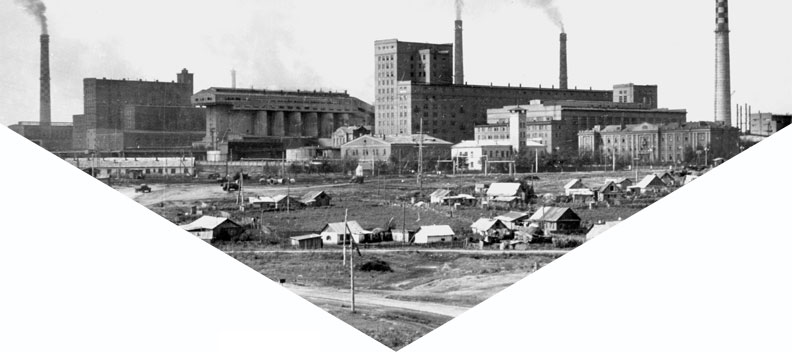
JSC "Bashkir Soda Company" was formed in May 2013 through the merger of OJSC "Soda" and OJSC "Kaustik." Today, JSC "BSK" is one of the largest chemical complexes in the country.

“SODA” PRODUCTION SITE
In the 1930s, as large-scale construction projects were launched across the country, an urgent need arose for soda ash and cement. Several regions were surveyed as potential sites for new manufacturing plants, with Bashkiria identified as the most promising location. In 1936, a team of geologists discovered that the Shikhan mountains near Sterlitamak contained vast reserves of limestone—a primary raw material for the production of both cement and soda. Furthermore, during the exploration of oil fields near the city of Ishimbay, large deposits of rock salt—the second essential component for the chemical production of soda—were also uncovered.
The site for the Sterlitamak Soda Factory was selected in 1939.
Construction of the factory began in 1941. Equipment evacuated from the Slavyansk and Donetsk soda plants in Ukraine started arriving at the site. The facility was built under the extremely harsh conditions of wartime. In March 1945, the first batch of caustic soda was produced, marking the beginning of the enterprise’s operational history.

In August 1945, the government decided to increase the national production of soda ash and caustic soda. Just six years later, the construction and equipment installation for the first phase of the soda ash production facilities were completed. On November 10, 1951, the Sterlitamak Soda Plant began regular production of soda ash.
Around the same time, in 1946, construction began on a cement plant. The first cement was produced in April 1952.
In 1952, construction of a roofing slate plant began next to the cement plant. The slate plant commenced operations on February 18, 1956.
All three facilities—the soda plant, the cement plant, and the slate plant—shared a common raw material base and an integrated supply system for electricity, water, and steam. On July 1, 1957, these operations were consolidated into the Soda-Cement Combine. Since the early 1950s, it has remained the largest industrial complex in Sterlitamak.
During the 1960s, the complex added facilities for the production of refined sodium bicarbonate (baking soda) and silica filler (white carbon black).
In the 1970s, the third phase of soda ash production was launched. New facilities were also established, including the country’s first plant for the production of dense soda ash, a unit for manufacturing construction-grade gypsum, a complex for barium production, and a facility for producing limestone flour for agricultural use.

In April 1975, the Sterlitamak Soda-Cement Combine was renamed the "Soda" Production Association.
During the 1980s and 1990s, facilities for the production of synthetic detergents and wall blocks were brought online, and a workshop for the production of carbon dioxide-based white carbon black (silica filler) was constructed.
In December 1994, by a decree of the head of the Sterlitamak city administration, the "Soda" Open Joint-Stock Company was registered, becoming the legal successor to the "Soda" State Production Association.
On July 1, 2008, the "Soda" Open Joint-Stock Company underwent a reorganization, resulting in the spin-off of two entities: "Construction Materials" Closed Joint-Stock Company and "Raw Materials Company" Closed Joint-Stock Company.
“KAUSTIK” PRODUCTION SITE
The history of the KAUSTIK factory began in 1951, when the Council of Ministers of the USSR issued an official decision to construct a chemical factory in Sterlitamak. This decision was prompted by the presence of the Yar-Bishkadak salt deposit—the primary raw material for the production of caustic soda—as well as abundant oil reserves. Ethylene, a derivative of oil refining, is used to produce ethylene dichloride, which in turn serves as a precursor for vinyl chloride and polyvinyl chloride (PVC).
JSC Kaustik considers August 8, 1964—the day the commissioning certificate for the first phase of the Sterlitamak Chemical Factory was signed—to be its founding date.
The initial structure of the factory included production units for caustic soda, chlorine, ethylene dichloride, hydrogen chloride, and hydrochloric acid. It also featured essential site-wide infrastructure, such as a nitrogen-oxygen unit, an ammonia-refrigeration unit, a central laboratory, biological wastewater treatment facilities, and a mechanical maintenance department.
Since hydrogen and chlorine are generated as by-products during the electrolysis of sodium chloride (table salt) solutions, the enterprise’s subsequent development focused on maximizing the utilization of chlorine to ensure both technological and environmental safety. In 1966, a polyvinyl chloride production unit with an annual capacity of 45,000 tons was brought into operation.
Between 1967 and 1975, production lines were launched for calcium hypochlorite, cable compounds, plastic films, consumer goods, and caustic soda (produced via the diaphragm method).
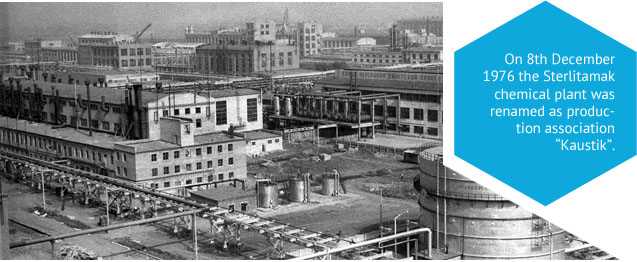
On December 8, 1976, the Sterlitamak Chemical Factory was renamed the "Kaustik" Production Association. During this period, the company commissioned facilities for the production of chlorinated polyvinyl chloride (CPVC), caustic soda (using technology from Oronzio de Nora), sodium hypochlorite, herbicides, and the incineration of organochlorine waste.
From 1982 to 1985, a production unit for the cationic polyelectrolyte VPK-402 was brought online, and a plant for the manufacture of non-standard equipment was established.
Between 1985 and 1988, production facilities for aluminum chloride, "Vikor" series corrosion inhibitors, and polyethylene polyamines were commissioned. In compliance with Resolution No. 781, dated August 14, 1987—titled "On Priority Measures for Environmental Protection in the Cities of Sterlitamak and Salavat, Bashkir ASSR"—the mercury-cell caustic soda and chlorine production process (using technology from the firm Krebs) was decommissioned, and environmental remediation measures, including mercury decontamination (demercurization), were implemented. Between 1989 and 2001, the company launched production facilities for polyvinyl chloride (PVC) flooring (linoleum) and tablecloths, as well as extruded products (profiles and PVC window frames). A vinyl chloride production complex with an annual capacity of 135,000 tonnes was built, the PVC production facility underwent a large-scale reconstruction that increased its capacity to 120,000 tonnes per year, and a research and technical center was established.
In 1991, the "Kaustik" production association was reorganized into a closed joint-stock company, "Kaustik."
From 2001 to 2003, production facilities for calcium chloride and plastic panels were commissioned, and the perchloroethylene production unit was reconstructed.
In the spring of 2013, OJSC "Kaustik" and OJSC "Soda" merged to form JSC "Bashkir Soda Company."